



Once the concrete is poured back over an interior drainage system, it disappears. You won’t see it again unless something goes wrong—and by then, the damage is already done. For homeowners across Philadelphia and the surrounding suburbs, that’s exactly why waterproofing decisions deserve more scrutiny than a quick price comparison.
Row homes in Fishtown, twins in Huntingdon Valley, and stone-foundation properties along the Main Line all share one thing in common: the ground underneath them is working against the basement, not for it. Clay-heavy soil, aging municipal storm systems, and a century of freeze-thaw cycles have turned water intrusion into one of the most common home repair calls in the region. This guide walks through what actually happens beneath that basement floor, how to evaluate a waterproofing system before you sign a contract, and what ongoing care looks like once the work is done.
Why Philadelphia Basements Are Especially Prone to Water Problems
Philadelphia sits on a mix of clay, shale, and compacted urban fill that doesn’t drain the way sandy or loamy soil does. When heavy rain hits, that clay holds onto moisture and swells, pushing outward against foundation walls. Engineers call this hydrostatic pressure, and it’s the single biggest reason basements in this region leak even when the walls look structurally sound.
Add in the age of the housing stock. Many neighborhoods still have homes with stone or rubble foundations built before modern drainage codes existed, and even newer construction often relies on grading and gutters alone to manage water. Combine that with narrow lot lines, shared party walls in row homes, and storm sewers that were never designed for today’s rainfall volumes, and you get a metro area where basement water intrusion isn’t a rare inconvenience—it’s an expected maintenance issue for a huge share of homeowners.
Neighborhoods like Northeast Philadelphia, Bensalem, and Abington see this play out differently depending on lot grading and proximity to older storm infrastructure, but the underlying cause is almost always the same: water finds the path of least resistance, and an unprotected basement wall is usually it.
What a Quality Waterproofing System Actually Includes
This is the part most homeowners never get to see, and it’s the part that matters most. A basement waterproofing system isn’t a single product—it’s a coordinated setup of components working together below the slab.
Interior Drainage Piping
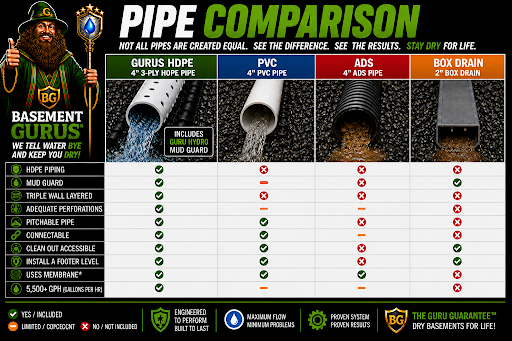
The core of most modern systems is a perimeter drain installed at footer level, along the base of the foundation wall. Pipe diameter and wall construction matter here. A triple-wall, heavy-gauge pipe holds up to soil pressure and won’t collapse or crush over time the way thinner single-wall tubing can. Pitch matters too—the pipe needs a consistent slope toward the sump pit, or water simply pools instead of flowing where it should.
Drainage Membrane
A dimpled drainage membrane, often installed against the foundation wall below floor level, channels water down into the perimeter drain rather than letting it seep directly through masonry joints. This layer is invisible once the floor is poured, but it’s doing constant work every time it rains.
Clean-Out Access Points
A system with no way to inspect or flush the piping is a system you’re trusting blindly for the next several decades. Accessible clean-outs let a technician check for sediment buildup or clogs without tearing up the floor, which matters more than most homeowners realize until they need it.
Sump Pump and Discharge Capacity
The drainage system is only as good as the pump moving water out of the house. Flow rate matters here—systems built to move several thousand gallons per hour handle sustained heavy rain far better than undersized pumps that were sold on price alone. A battery backup is worth asking about too, since Philadelphia’s worst storms often knock out power at the exact moment the pump is needed most.
If you look at a side-by-side pipe comparison chart from any reputable waterproofing company, the difference between a heavy triple-wall HDPE system and a standard PVC or corrugated pipe becomes obvious—wall thickness, perforation placement, and connectability all affect how the system performs ten or twenty years down the road, not just on day one.
If you’re weighing quotes right now, ask each contractor to walk you through their pipe specifications and drainage capacity before discussing price. That single conversation tends to separate serious waterproofing companies from crews doing a patch job.
Signs Your Basement Needs Professional Attention
Water damage rarely announces itself all at once. It shows up in small signals first:
- A musty smell that returns no matter how often you run a dehumidifier
- White, chalky mineral deposits (efflorescence) on concrete block walls
- Water stains or discoloration along the cove joint where the wall meets the floor
- Peeling paint or bubbling drywall near the basement’s lower half
- Visible cracks in the foundation wall, especially horizontal ones
- Standing water after storms, even if it disappears within a day
- Rust forming on stored metal items or appliances
Any one of these on its own might seem minor. Together, or recurring after every significant rainfall, they’re a pattern worth having inspected before the next heavy storm season.
Common Mistakes Homeowners Make When Comparing Contractors
Choosing based on the lowest bid alone. A dramatically cheaper quote usually means thinner piping, no clean-outs, or a pump sized for average conditions instead of worst-case ones. The savings show up immediately; the cost shows up in year three or four.
Not asking what happens to the pipe after installation. Once concrete is poured, the system is essentially permanent. If a contractor can’t clearly explain pitch, clean-out access, and pipe material, that’s a system you can’t verify later.
Assuming a sump pump alone solves the problem. A pump is only the last step. Without proper drainage collecting water and directing it to the pit efficiently, even a strong pump is working against poor design.
Ignoring exterior grading and gutters. Interior systems manage water that’s already found its way in, but simple fixes—extending downspouts, regrading soil away from the foundation—reduce how much water reaches the wall in the first place.
Skipping the written warranty details. Ask specifically what’s covered, for how long, and whether it transfers to a new owner if you sell the home. Vague verbal promises don’t hold up when a claim needs to be filed.
Not sure how your current quote stacks up? Getting a second opinion before signing anything costs nothing and often reveals gaps the first estimate glossed over.
How Professional Waterproofing Actually Works
A properly run project typically follows a consistent sequence, regardless of which company handles it:
- Inspection. A technician evaluates wall condition, existing cracks, grading, and where water is entering—interior symptoms alone don’t always match the exterior source.
- System design. Pipe routing, sump pit placement, and pump sizing get mapped to the specific home, not a one-size-fits-all template.
- Trenching. A narrow channel is cut along the interior perimeter at footer level, where the wall meets the floor.
- Pipe and membrane installation. Drainage piping is set with proper pitch, connected to clean-outs, and paired with wall membrane where needed.
- Sump pit and pump installation. The pit is sized to hold sufficient water volume, and the pump is matched to the home’s drainage load.
- Concrete restoration. The trench is sealed back over, restoring the floor while leaving the system fully functional beneath it.
- Final walkthrough. A finished project should include a clear explanation of what was installed and how to monitor it going forward.
Beyond Waterproofing: Foundation Repair and Mold Concerns
Waterproofing helps prevent future water intrusion, but it cannot reverse existing damage. Persistent moisture softens mortar joints, accelerates concrete deterioration, and eventually contributes to bowing or cracking walls—structural issues that need their own repair approach, sometimes involving wall anchors, carbon fiber reinforcement, or footer stabilization depending on severity.
Mold is the other half of this equation. Basement humidity above roughly 55% creates conditions where mold colonies can establish within 24 to 48 hours on organic material like wood framing or drywall paper backing. Mold remediation isn’t just about visible removal—it requires addressing the moisture source first, or growth returns within weeks. A basement that’s been waterproofed but never had its air quality addressed can still carry lingering spore issues, which is why drainage work and dehumidification often get recommended together.
Maintaining Your System After Installation
A waterproofing system needs minimal but consistent attention:
- Test the sump pump twice a year by pouring a bucket of water into the pit and confirming it activates and drains properly.
- Check the battery backup if one is installed, since batteries lose capacity over several years even without being used.
- Keep clean-out access points clear of stored boxes or furniture so they’re reachable if inspection is ever needed.
- Walk the exterior perimeter after heavy storms, checking that downspouts extend away from the foundation and grading hasn’t shifted.
- Schedule a professional check-in every few years, particularly if the home is older or has a history of water issues.
None of this takes much time, but skipping it is how a well-installed system ends up underperforming a decade in.
Areas We Serve Across Greater Philadelphia
Basement Gurus works with homeowners throughout Philadelphia, Northeast Philadelphia, Huntingdon Valley, Bensalem, Abington, Cheltenham, Jenkintown, Elkins Park, Lower Merion, and the Main Line, along with the broader Greater Philadelphia region. Local soil and housing conditions vary block by block, which is part of why an in-person inspection matters more than a generic estimate over the phone.
Conclusion
A dry basement isn’t the result of one product or one clever sales pitch—it’s the result of a well-designed system that’s rarely seen again after installation day. Understanding what goes into that system, from pipe wall thickness to sump pump capacity, puts homeowners in a much stronger position when comparing contractors and quotes. Philadelphia’s soil and housing stock make water intrusion a near-guarantee over time for many properties, but a properly engineered drainage system, paired with routine maintenance, keeps that risk manageable for decades.
If your basement has shown any of the warning signs above, or you simply want a second opinion on a quote you’ve already received, Basement Gurus offers inspections across the Greater Philadelphia area and can walk you through exactly what a properly built system looks like for your home.
Frequently Asked Questions
How much does basement waterproofing cost in Philadelphia? Pricing depends on basement size, the extent of water intrusion, and whether interior drainage, exterior work, or both are needed. Most homeowners get a clearer number after an in-person inspection, since online estimates rarely account for soil conditions or foundation type.
How long does a basement waterproofing installation take? Most interior drainage installations take one to three days for an average-sized basement. Larger homes, or projects that include exterior excavation or structural repair, can take longer.
Will waterproofing my basement stop mold from coming back? It addresses the moisture source, which is the root cause of most mold growth, but existing mold on surfaces typically needs separate remediation. Pairing drainage work with a dehumidifier gives the most reliable long-term results.
Is interior or exterior waterproofing better for Philadelphia homes? Interior drainage systems are generally less invasive and more cost-effective for row homes and properties with tight lot lines, which describes much of Philadelphia. Exterior waterproofing can be appropriate in specific cases, particularly for new construction or homes with accessible foundation walls.
Can I install a French drain myself? DIY exterior drains can help with surface water and downspout runoff, but interior perimeter systems tied to a sump pump require precise pitch, proper pipe sizing, and code-compliant sump pit installation. Getting the pitch wrong even slightly can cause water to pool instead of drain.
How do I know if my sump pump is strong enough? Pump capacity should match your home’s drainage load, not just basement square footage. A technician can calculate this based on your system design, but as a general signal, homes with a history of heavy water intrusion typically need higher flow-rate pumps with battery backup.
Does homeowners insurance cover basement waterproofing? Standard homeowners insurance typically doesn’t cover gradual water seepage or preventive waterproofing, since it’s considered a maintenance issue rather than a sudden loss. Coverage varies by policy, so it’s worth confirming directly with your insurer before assuming either way.
What’s the difference between a foundation crack and a structural issue? Small vertical hairline cracks are common and often not urgent, especially in poured concrete walls. Horizontal cracks, stair-step cracks in block walls, or cracks wider than a quarter inch are more likely to indicate pressure or settlement issues that warrant a structural evaluation.