



If you’ve lived in Lancaster County long enough, you know a heavy rain doesn’t just mean a wet driveway. It means checking on the basement. Between the clay-heavy soil around the Susquehanna and the older stone and cinder block foundations common throughout the county, a lot of local homes are working against the odds every time a storm rolls through.
Basement waterproofing in Lancaster, PA isn’t about reacting after water shows up on the floor. It’s about understanding what’s happening underground before that ever happens, and putting a system in place that manages it. Here’s what every homeowner should know before the next round of rain.
Why Basement Leaks Start Underground
A lot of homeowners assume basement leaks are caused by rain finding a crack and dripping through. In reality, the process starts well before any water touches your foundation wall, and it’s worth understanding step by step.
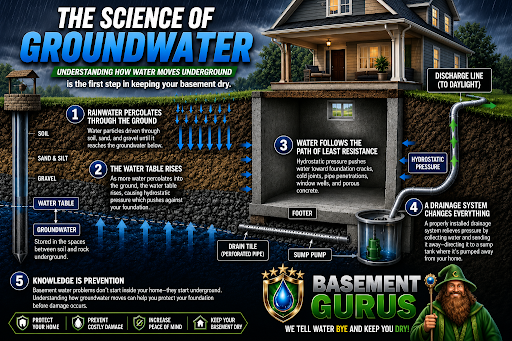
Rain doesn’t sit on top of the ground for long. It filters down through the soil, sand, and gravel layers until it reaches the natural groundwater stored below your property. During a heavy or extended storm, that underground reservoir fills up faster than it can drain, so the water table climbs. As it rises, the saturated ground presses outward against anything in its way, including your foundation walls and slab. That pushing force is what’s known as hydrostatic pressure, and once it builds up enough, water stops sitting still and starts searching for an exit. It typically finds one at a crack, a cold joint between the wall and floor, a window well, or a porous stretch of concrete block. If you’ve seen the underground diagram we’ve shared with this post, this is exactly the chain of events it illustrates: rainfall down, water table up, pressure out, and water in wherever your foundation is weakest.
Hydrostatic Pressure and Lancaster County Soil
Lancaster County sits on a mix of clay-heavy and limestone-influenced soils that don’t drain particularly well. When a home is built, the soil that goes back around the foundation is looser than the undisturbed ground around it, so it holds more water. That loose, saturated backfill presses against the foundation with far more force than most homeowners realize, which is why older stone and cinder block foundations in particular are prone to bowing, cracking, and seepage over time.
This is also where a properly designed drainage system earns its keep. A perforated drain line set along the footer collects water before it ever reaches your basement floor, while the sump pump and discharge line carry it away from the home entirely. Instead of fighting the water table head-on, the system simply gives the water a shorter, easier path than your foundation, which is the whole point of interior drainage.
The 10-Point Pre-Storm Basement Checklist
Before the next significant rain event, walk through these checks. Most take five minutes and can save you a much bigger headache.
- Confirm your sump pump is plugged in and running. It sounds obvious, but a pump that got unplugged during cleaning or unseated after a power outage is one of the most common causes of preventable flooding.
- Test it with a bucket of water. Pour water directly into the pit and watch the pump kick on, move the water, and shut off correctly.
- Check the discharge line. Make sure it isn’t clogged, frozen, or disconnected outside the home.
- Clean out your gutters. When gutters become clogged, water is diverted toward your home’s foundation rather than away from it.
- Extend your downspouts. Water should discharge at least four to six feet from the foundation, not pool right at the base of the house.
- Look for cracks in basement walls or floors, especially any that seem to be growing or letting in moisture.
- Inspect basement windows for fogging, staining, or gaps around the frame.
- Watch for musty odors, peeling paint, or white mineral deposits (efflorescence) on walls, all early warning signs of moisture intrusion.
- Move valuables off the basement floor before a heavy rain event, especially storage boxes, electronics, and furniture legs.
- Ask yourself honestly: if it started pouring while you were at work, would your basement stay dry?
If any of these checks give you doubts, that’s the moment to get an inspection rather than wait for the next storm to answer the question for you.
Signs You May Need Basement Waterproofing Services
Beyond the pre-storm checklist, there are longer-term signs that point to a bigger underlying issue:
- Recurring dampness after every rain, even light ones
- A sump pump that runs constantly during wet weather
- Visible mold or a persistent musty smell
- Cracks that widen, shift, or reappear after patching
- Efflorescence or paint peeling on foundation walls
- A basement that’s simply too humid to use for storage
Any one of these is a signal worth having checked. Together, they usually mean water is finding a consistent path into the home and a cosmetic fix won’t hold.
Finding the Right Basement Waterproofing Contractors in Lancaster, PA
Not every basement waterproofing company approaches the problem the same way, and pricing can vary quite a bit depending on the method used and the severity of the issue. A few things matter more than a low quote:
- A real inspection, not a sales pitch. A qualified basement specialist in Lancaster, PA should walk your property, identify your foundation type, and explain where water is actually entering before recommending a fix.
- Experience with local conditions. Contractors who understand Lancaster County’s soil composition and older housing stock, from stone foundations to cinder block builds common through the 70s, 80s, and 90s, are better equipped to design a system that lasts.
- Transparent, documented recommendations. You should walk away understanding exactly what’s being installed and why, not just a price.
- Verified reviews and licensing. Checking references and past project photos tells you more than a company’s own marketing ever will.
At Basement Gurus, our team has spent more than two decades inspecting and waterproofing basements across Pennsylvania, New Jersey, Delaware, and Maryland, including throughout Lancaster County from Ephrata and Lititz to Strasburg and Mount Joy. Every inspection starts with identifying the actual source of the water, not just patching the symptom.
From Wet to Livable: Basement Finishing in Lancaster, PA
Once a basement is properly waterproofed, it opens the door to something a lot of homeowners don’t consider right away: usable square footage. Basement finishing in Lancaster, PA only makes sense after moisture control is handled, since finishing a basement that still takes on water just hides the problem behind new drywall. Once the water is managed, that same space can become a family room, home office, or guest suite that actually holds up over time.
FAQs
How Do I Know If It’s Time to Waterproof My Basement in Lancaster, PA? Watch for musty odors, visible mold, peeling paint, or damp floors after rain. If your sump pump runs constantly during storms or you notice new cracks, it’s worth scheduling a free inspection.
What’s the most effective basement waterproofing method for Lancaster homes? The answer depends on where the water is coming from. For most homes, an interior drainage system paired with a sump pump handles groundwater and seasonal flooding effectively. Homes with severe exterior pressure, large cracks, or older stone foundations may need exterior waterproofing or structural repair as well.
How much does basement waterproofing cost in Lancaster, PA? Cost depends on foundation type, the extent of the water problem, and whether structural repair is involved. A trustworthy basement waterproofing company will provide a free inspection and a clear, itemized estimate before any work begins.
Does winter freeze-thaw make basement leaks worse in Lancaster? It can. Water that seeps into small foundation cracks during fall rains can freeze in winter, expand, and widen those cracks further. That’s part of why a lot of local leaks that seemed minor in November show up as a real problem by the following spring.
Can I handle minor basement leaks myself, or should I call a professional? Sealing a hairline surface crack or caulking a window frame is reasonable DIY territory. But if water is coming through the wall-floor joint, appearing in multiple spots, or showing up every time it rains, that usually points to a pressure or drainage issue underground that surface patching won’t fix.
Will homeowner’s insurance cover basement waterproofing or water damage repair? Most standard homeowner’s policies don’t cover gradual water seepage or groundwater intrusion, since it’s considered a maintenance issue rather than a sudden event. Sump pump failure or flood coverage may fall under separate riders. It’s worth checking your specific policy, but waterproofing is generally an investment homeowners make proactively rather than something insurance pays for after the fact.
What Is the Expected Life of a Basement Waterproofing System? When installed correctly, interior drainage systems and sump pumps can protect a home for decades, particularly with routine sump pump maintenance and periodic checks.
Before the Next Storm Rolls In
Basement leaks rarely happen because of one storm. They happen because the ground underneath a home has been quietly building pressure for years, and the next heavy rain is simply the moment it finds a way in. If any part of the checklist above raised a flag, or if it’s just been a while since anyone looked closely at your foundation, it’s worth having a professional take a look before the water decides for you.
If you’re noticing dampness, odors, or cracks in your Lancaster County basement, reach out to Basement Gurus for a free, no-pressure inspection. We’ll walk the space with you, explain exactly what we find, and help you decide on next steps, whether that’s a simple fix or a full system.