



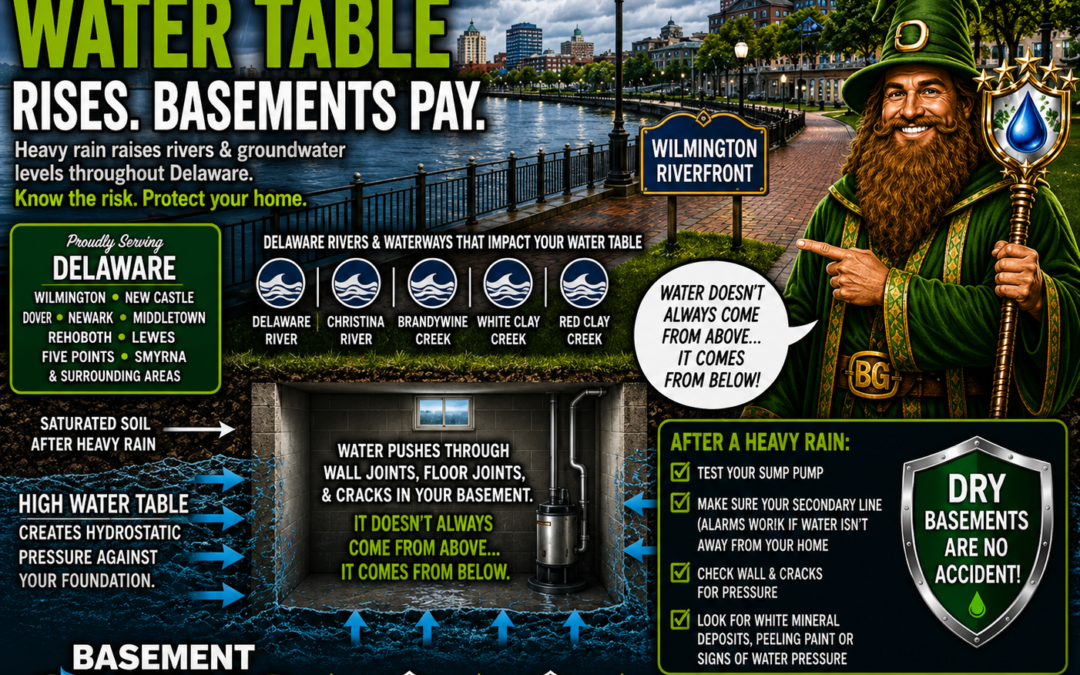
Most homeowners assume a wet basement means a roof leak, a bad window seal, or rain finding its way in from above. In Wilmington, that assumption is often wrong. The Delaware River, Christina River, Brandywine Creek, White Clay Creek, and Red Clay Creek all sit close enough to New Castle County neighborhoods that they influence the groundwater table underneath thousands of homes, and when that table rises, basements pay the price from the ground up.
If you’ve ever mopped up water after a storm and wondered why it kept coming back through a wall that never touched the rain, this article explains what’s actually happening beneath your foundation and what you can do about it.
How Local Rivers and Creeks Affect Your Basement
Wilmington sits inside a network of waterways that most residents drive past without a second thought. The Christina River cuts through the city itself, the Brandywine winds down from Pennsylvania, and White Clay and Red Clay Creeks feed into the watershed from Hockessin, Pike Creek, and Newark before eventually reaching the Delaware River.
These waterways don’t just carry surface water. They sit on top of the same aquifers and saturated soil layers that surround your home’s foundation. When heavy rain hits, river and creek levels climb, but so does the groundwater table for miles around, including under neighborhoods in Bear, Middletown, New Castle, and every community in between. Your basement doesn’t need to be near a riverbank to feel the effect. A rising water table pushes upward and inward against foundation walls and slabs no matter how far you are from the nearest creek.
This is the piece that a lot of general advice about waterproofing in Wilmington DE skips over. A homeowner in Pike Creek might be a mile from White Clay Creek and still deal with the exact same groundwater intrusion as a house two blocks from the water.
What Is Hydrostatic Pressure, and Why Does It Matter?
Hydrostatic pressure is the force that saturated soil places against your foundation once the ground can’t absorb any more water. Picture soaked soil acting like a full sponge pressed against your basement wall. The water inside it wants to go somewhere, and the path of least resistance is usually through the weakest point in your foundation.
That weak point could be:
- A cold joint where the foundation wall meets the footer
- Hairline cracks in poured concrete
- Mortar joints in a block foundation
- Gaps around pipe penetrations
- Even porous, uncracked concrete under enough pressure
This is why a basement can flood along the bottom of a wall, or bubble up through a floor seam, without a single drop falling from above. Once you understand hydrostatic pressure, it becomes obvious why sealing a visible crack with caulk rarely solves anything long-term. The pressure is still there, and it will simply find the next weak spot.
Signs Your Basement Is Fighting a Losing Battle With Groundwater
Groundwater intrusion is rarely dramatic at first. It tends to announce itself quietly, then all at once during a major storm. Watch for:
- Visible white mineral stains on foundation walls caused by efflorescence
- Paint that’s bubbling, flaking, or peeling near the floor line
- A musty smell that shows up mainly after rain
- Damp corners, especially where two foundation walls meet
- Rust forming on metal support posts or HVAC equipment
- Small cracks that seem to widen slightly year over year
- A sump pump that runs constantly during storms but the floor still feels damp
Any one of these on its own might not mean much. Two or three together, especially recurring after every significant rain event, usually points to a groundwater problem rather than a one-time leak.
The Post-Storm Checklist Every Wilmington Homeowner Should Run
Building a habit of checking your basement after every heavy rain catches small issues before they become expensive ones.
Test the sump pump. Pour a bucket of water into the sump pit and watch it cycle. It should kick on quickly, move water efficiently, and shut off cleanly. A sluggish response is often the first sign a pump is aging out.
Trace the discharge line. Walk outside and confirm the line carries water at least 10 feet from the foundation. A discharge line that dumps water right next to the house is essentially recycling the same water back toward your basement.
Walk all four corners. Corners are where two walls meet and where water pressure often concentrates first. Feel for dampness, not just standing water.
Look low on the walls. Mineral staining, peeling paint, and soft drywall near the floor line are early indicators worth photographing and tracking over time.
If any of these checks turn up a problem, it’s worth having a basement waterproofing company in Wilmington DE take a look before the next storm rather than after.
Common Mistakes Homeowners Make With Wet Basements
Painting over the problem. Waterproof paint can mask a damp wall for a season, but it doesn’t stop hydrostatic pressure. Eventually the moisture finds a new path or pushes the paint off entirely.
Assuming a sump pump alone is “waterproofing.” A sump pump is one piece of a system. Without proper interior drainage feeding into it, water can still travel through walls and floors before it ever reaches the pit.
Ignoring a slow, recurring smell. A musty odor that shows up only after rain and fades a few days later is often dismissed as “just an old basement smell.” That pattern is a strong signal of groundwater cycling in and out.
Waiting for a flood to act. Foundation cracks tend to widen gradually. Addressing a hairline crack today is far less invasive and less costly than dealing with a structural repair after years of pressure.
DIY exterior digging without a plan. Some homeowners attempt to regrade or dig along a foundation wall themselves. Without proper drainage design, this can trap even more water against the wall instead of directing it away.
How Foundation Repair and Waterproofing Actually Work Together
Waterproofing and foundation repair often get treated as separate services, but in a groundwater-driven region like Wilmington, they’re closely linked. A foundation repair contractor in Wilmington DE typically starts by identifying whether cracks or bowing walls are cosmetic or structural. From there, waterproofing addresses where the water is coming from, while foundation repair addresses the physical damage that pressure has already caused.
A typical process looks like this:
- Inspection – Identifying moisture entry points, crack patterns, and grading issues around the exterior.
- Diagnosis – Determining whether the cause is surface water, groundwater, or a combination of both.
- Interior or exterior drainage – Installing a system that intercepts water before it enters living space and channels it to a sump pump.
- Structural correction – Repairing cracks, reinforcing walls, or stabilizing settling sections where needed.
- Verification – Testing the system, often including a pump test, to confirm water is moving as designed.
Skipping straight to foundation repair without addressing drainage often leads to repeat cracking down the road, since the pressure that caused the original damage never actually went away.
Why Subfloor Matters After a Wet Basement Repair
Even after water intrusion is controlled, protecting the floor level remains essential. A basement subfloor system in Wilmington DE creates a buffer between the concrete slab and any flooring, furniture, or finished living space above it.
Concrete slabs stay in contact with residual ground moisture even in a properly waterproofed basement, simply because they sit directly on soil. A raised, moisture-resistant basement subflooring system allows air to circulate underneath, reducing the chance of trapped condensation, warped flooring, or musty odors down the line. For homeowners planning to finish a basement for storage, a home office, or a family room, installing subfloor after waterproofing rather than before is the order that actually protects the investment.
Seasonal Maintenance to Keep Groundwater Out
- Spring: Check that gutters cleared winter debris and downspouts still direct water away from the foundation.
- Summer: Watch for cracks in exterior soil from dry conditions, which can widen gaps around the foundation once rain returns.
- Fall: Clear leaves from gutters before winter storms increase runoff volume.
- Winter: Confirm the sump pump has a working battery backup in case of a power outage during a snowstorm or ice event.
A five-minute check each season goes a long way toward catching a small issue before it becomes a wet basement emergency.
Conclusion
A wet basement in Wilmington is rarely bad luck. More often, it’s the predictable result of a rising water table, hydrostatic pressure, and a foundation that’s been quietly absorbing that stress for years. Understanding how the Delaware River, Christina River, Brandywine Creek, White Clay Creek, and Red Clay Creek influence the ground beneath your home puts you in a much stronger position to catch problems early, whether that means testing your sump pump after a storm or having a foundation reviewed before a small crack becomes a structural one.
If your basement has shown any of the warning signs above, the team at Basement Gurus offers free inspections across Wilmington and the surrounding New Castle County communities to help you understand exactly what’s happening beneath your home and what it will take to keep it dry.
Frequently Asked Questions
Why does my basement leak even when it’s not raining directly on that wall? Groundwater doesn’t need to fall on a specific spot to affect it. Once the soil around your entire foundation becomes saturated, hydrostatic pressure pushes water toward the nearest weak point, which can be a wall or floor joint far from where rain actually landed.
How do I know if my wet basement is caused by surface water or groundwater? Surface water problems usually show up quickly during a storm and dry out fairly fast afterward. Groundwater intrusion tends to linger, often appearing as damp walls, mineral deposits, or musty odors that persist for days after rain has stopped.
Is a sump pump enough to keep my basement dry? A sump pump handles water once it reaches the pit, but it doesn’t stop water from entering walls or floors in the first place. Pairing a pump with proper interior or exterior drainage gives it water to actually manage instead of leaving gaps for moisture to bypass it.
How frequently should I test my sump pump? Testing after every major storm is ideal, but at minimum, test it once each season and always before the start of a wet stretch like early spring. Pouring a bucket of water into the pit is a quick, reliable way to check.
Can foundation cracks from hydrostatic pressure get worse over time? Yes. Pressure against a foundation doesn’t relieve itself. A hairline crack today can widen gradually with each saturated season, which is why addressing the source of pressure matters as much as sealing the crack itself.
Do I need a basement subfloor system if my basement is already waterproofed? It’s not mandatory, but it’s a smart addition if you plan to finish the space. Since concrete slabs stay in contact with residual ground moisture, a raised subfloor helps prevent trapped condensation and keeps finished flooring performing well over time.
How much does basement waterproofing typically involve? Scope varies by home, but most projects start with a free inspection to diagnose the entry point, followed by a tailored plan that might include interior drainage, sump pump installation, crack repair, or exterior sealing depending on what the inspection reveals.